Tuesday, May 18, 2021

Course update

     It has been awhile since I last updated my blog.  Lots of thing have been going on.  Spring is here and summer is not far off.  Over the past winter we cut down 40 trees and cleaned up the tops of 10 trees to the right of #1 green.  I can tell you this my staff and I are tired of cutting timber.  These tree removals will improve playability of the golf course.  We still have work to be done.  All of the stumps have to be remove.  My stump guy has us on the schedule.  When stumps are cleaned up we will sod cart paths at #1 green and #10 green.  This will be a big improvement to these 2 areas.

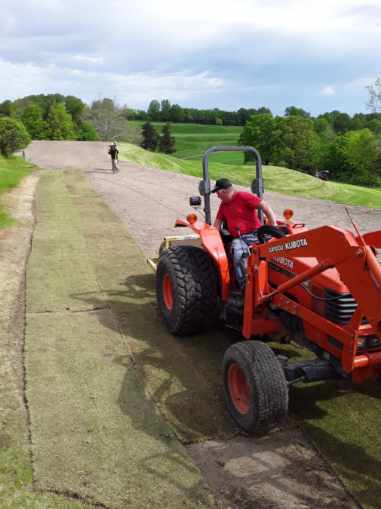
     The Driving Range Tee, #4, #6 and #9 Black tees got a makeover this month.  We stripped all sod off the tees, tilled them up and laser leveled all four tees.  It took almost 2 weeks to get new Zoysia sod.  The rain kept sod farm too wet to cut zoysia sod.  We laid sod and then it decided to turn unseasonably cool.  The zoysia on the tees is finally sending roots down.  We are trying to get these tees open by end of May. 


                               Tilling up Tee                                            Laser leveled tee

                                                                           
laying sod
completed


    We just had Commercial Turf here to root prune all trees along fairways, tee and greens.  This will help our turf in all areas.  Trees will out complete turfgrass for water and food.  We will need to redo this about every 2 to 3 years.  The machine has 2 knifes 12'' apart cutting 9 inch deep slit.  This does not harm the trees.  We were cutting feeder roots just on the edge of the drip line.


Wednesday, February 17, 2021

Big Freeze

      It is that time of year.  With the bitter cold temperatures the ground has frozen solid.  Later in the week we will have temperatures climb up to near 50 degrees.  Greens need to thaw to at least 2'' before play is allowed.  The green surface needs sunlight to help in the thawing process.  Snow cover will slow this process up.  When snow melts we will be checking greens multiple times a day when we have at least 2'' of thaw in all our greens we will open.  Root shearing can cause severe turfgrass problems.  Diagram below show how root shearing is done by playing on thawing greens.  Thanks for your cooperation.   


Tuesday, February 16, 2021

Tree work

     We have been very busy working on underbrush and tree removal the past 2 months.  We started with underbrush to the east side of 10 green and worked our way down the fence to 12 black tee.  Air movement is what we are trying to enhance on 10 and 11 greens.  The next  thing was to remove 10 trees around 10 green.  This will help with light, air movement and help establish much better turf on the back side of 10 green.  We will be removing 4 trees to the south and east of 11 green also.  These trees are shading 11 green.  All trees removed were trees selected by the USGA Agronomist John Daniels during his visit last summer.  There are 2 trees at #11 we are cutting down because they are leaning heavy over the fence.  If they fall it will destroy the fence giving the cattle access to the golf course.


     Some of the trees removed from #10 were in bad shape.  We cut two trees down that were hollow.  the picture below is the tree that was right next to cart path leaving 10 green.
     After we remove the stumps we are going to grade and sod both sides of cart path behind 10 green.  This will be a huge improvement.  Trees will not allow good turf to grow under them.  Below are some pictures of both 10 and 11.

10 green

We chipped the tops

10 green

11 green

We cut brush and then chipped it with our chipper

11 green completed

My staff has worked very hard.  We were able to cut down and clean up 2 trees a day unless play was heavy.  We had a few days the golf course was extremely busy for winter.


Friday, October 16, 2020

Course Update

      It has been awhile since my last post.  We have been very busy.  We have a number of project that have been completed.  One of the biggest accomplishments is our greens are almost healed up from the Nematode and Root Rot issues from July.  This was the hardest summer I have ever had in my 35 years as a Golf Course Superintendent. I am optimistic this will not happen again. I have a different approach for next year.  I am  build my soil biology up with biological products that will grow greater root mass in our greens and have a negative effect on Nematodes.  Some of these biological product are in fact natural Nematicides.  I have always used biologicals but not to this extreme.  Some of these products  like crab shell meal, soap box tree extract, compost, sesame seed oil all have some degree of control to Nematodes.  I am also using some forms of Bacteria and Fungi products that also have  control against Nematodes. I know I will not kill all of them but if I can keep numbers low enough to get our greens through July and August with minimal damage that is a win.

Here are the list of project we completed since  August.  

  • #4 fairway bunker was rebuilt.
  • #8 cart path from ditch in front of green up past merge from #17 was fixed.
  •  #1 trees to north of green were removed to help with turf loss on right side of green below bunker. 
  •  Aerified all greens.
  •  DryJect all greens.
  • Fixed cart path washouts on holes 6 and 12. 
  • Sprayed second application of Bermuda grass control on fairways and tees.  
  • Fix sink hole that developed at the front entrance from bad culverts.
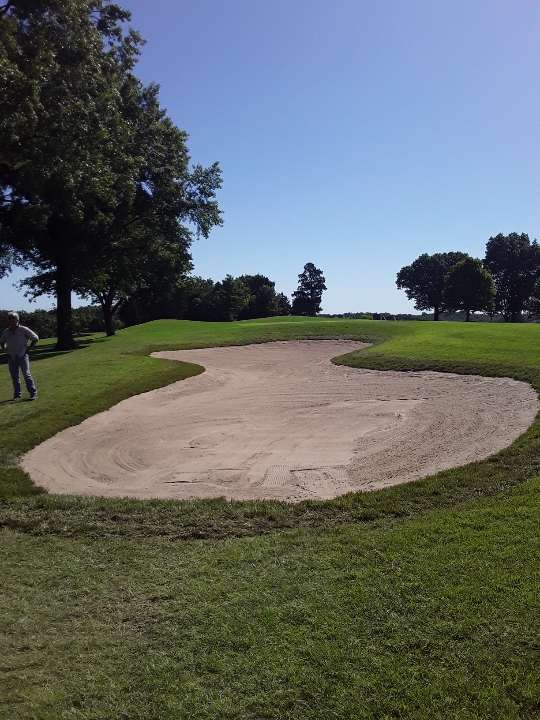
     #4 fairway bunker was reshaped and bottom was raised about a foot.  New drain lines and sand installed.  This was a much needed improvement.  

Schaefer-Meyer edging bunker
#4 bunker finished

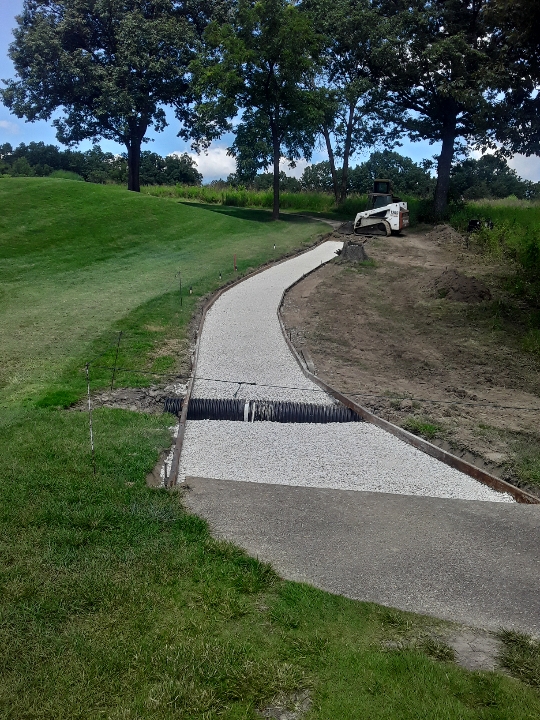
     #8 cart path was in bad shape.  We had about a 2 foot ditch running under the path.  We also put a culvert in at ditch crossing.  No more carts running through water.  Dobsch Construction did great work.
You can see the ditch running under path

Ready for concrete
Just finished second pour.
Sod going down.

     We removed some big trees to north of #1 green.  It is very hard to get any turf to grow near the cart path.  The large trees were taking all of the moisture.  This will help us to maintain better quality turf from the bunker to cart path turn behind #1 green.  We still have to remove the under brush and clean up the tree tops.

Before from back of green

Before front right of green
After from behind green
After from front right of green

     We aerified all of greens twice this fall.  In late September we punch holes with our ProCore.  This is the first time we were able to aerify, topdress, brush, apply fertility and water in one day.  We used 3/8 tines.  Most holes were filled in by the end of the week.

Picture taken after we brushed greens .

     October 5th we did a new process called DryJect.  DryJect takes water to create a void in profile of green and sand is sucked back into the hole.  I ordered some finely ground compost and we mixed it with our dry sand.  We used 80 lbs of compost to 2000 lbs of sand.  This makes roughly a 95% sand to 5% compost blend.  The compost will give our greens organic matter to help fight off Nematodes.  The compost product has shown some good success in Florida.  We will do this again next March before we core aerate.  DryJect is very labor intensive.  The DryJect crew brought 2 machines.  We needed 3 people per machine to keep our blended sand in machine as it went across green.  We used 24 tons of sand and it had to  be hand loaded into the hopper of the DryJect machine.

Loading DryJect machine

3''X3'' hole pattern

     The cart paths that cut across the fairways on holes 6 and 12 were repaired.  This is not the first time we have repaired these two areas.  Water uses the edge of path on 6 and it cuts out the sod.  Once water get a channel it keeps on eating it out.  #12 cart path is a different situation.  Before we put the catch basin in at the fence any big rain event we would get mud and silt would come down from the farm to the north of the golf course.  Just before you make the turn to go across the fairway we have about 1 foot of mud and silt that was washed down from the farm above us.  This changed the drainage pattern of the rough and fairway.  Water now sets along the cart path when it used to flow down the hill to the ditch.  We will see if our fix will work.  We might have to put a catch basin in at cart path if it comes back.

Cart path at 12 Fairway.

     The past 3 years we have been spraying the bermuda grass encroachment in our fairways and tees.  This is a slow process Bermuda grass is relentless.  Just like the Energizer bunny it just keeps going. We are making some progress.  I am using two different herbicides to take the Bermuda grass out of our Zoysia fairways.

The off color turf is Bermuda grass
Closeup of Bermuda grass injury from herbicides.


     Lastly we found a sink hole at the front entrance.  After some exploratory digging we found the problem.  We have 2 culverts that merge together at our driveway and Country Club Rd.  The old forms that were used to connect the two pipes into the concrete box culvert going under Country Club Drive rotted away and the gravel under the asphalt was washing into the box culvert.  Luckily we found this before a vehicle did.  We replace both rusted culvert pipes. We replaced them with ADS plastic pipe, concreted it back to the box culvert running under Country Club Rd.  We need a good rain so the rock fill can settle.  After fill has settled we will repair asphalt.
Old culvert running into box culvert.
  
Installing new culvert pipe.
Concreting pipes into box culvert.


Sunday, August 23, 2020

Bermuda eradication

     The past 3 years we have treated our fairways and tees to stop the spread of Bermuda grass.  We have Bermuda grass all over the golf course.  Our fairways and tees were sodded in Zoysia grass back in the mid 90's.  Bermuda has encroached into the fairways and tees.  In some places it has out competed the Zoysia.  I am using a combination of  herbicides to knock back the Bermuda.  This is a slow process.  We need to treat fairways 3 times one month apart.  The Bermuda will turn brown but will begin to grow out of the effects of the herbicides in about 3-4 weeks that is why we need multiple apps per year.  We can see up to an 80% reduction in a year.  While your playing you will see some brown grass in areas.  That is the Bermuda grass.  Below are a few pictures

Dan spraying Herbicide to #4 fairway
Bermuda control in #6 fairway.  Bermuda is brown while Zoysia stays green.
Bermuda control in the perimeter cut beginning #18 fairway

Thursday, August 6, 2020

Update on Greens

     I would like to update everyone on the greens.  I will be the first to say I am not happy at all with what has happened to the greens. This is very disheartening.  My staff and I work very hard to give the membership the best playing conditions possible.  For this to happen has been a punch in the gut .  I can tell you this,  we are working very hard so this does not happen again. 
     Most of you know we have been battling Nematodes in our greens for the past 6 years.  Dr. Miller from the University of Missouri found them examining a plug I sent him from a bad spot on #5 green back in 2014. I am certain we have had problems with Nematodes in our greens for many years.  Nematodes attack the root system of turfgrass.  Greens are extremely susceptible to damage because of the low mowing heights of the grass. Nematodes live in the soil most feed on roots from the outside and a few burrow into the root and feed from the inside.  The ones that go inside the roots are the hardest to control.  Anytime you have a pest that pierces or burrows into roots you can have problems with root infecting diseases also.   I have been treating our greens with nematicides this entire season.  I have been trying to kill one species of Nematode, Lance.  The past few years Lance has been our biggest problem.  Lance is the only nematode that does not have a good control option available.  We can kill all other Nematodes that attack turfgrass easily. There is one nematicide that is labeled to kill Lance it is called Divanem.  The problem with Divanem is it gets tied up in the thatch and organic matter of the soil so it only goes down to about one inch into the soil.  One inch is not deep enough to reach Lance nematode.  My thinking was if I aerate the greens to create a channel down into the soil profile I could get the nematicide down to where the Lance nematodes live.  That did not work.  Dr. Crow from the University of Florida told me that it will go down in the aerifying hole but will not move laterally.  He also told me if I was using nematicides to control Lance I would not get very good control of Lance but  would kill other nematodes.  Without competition,  Lance numbers will grow higher.  With the higher number of Lance, the damage to the turf is greater.
      I started to spot symptom near the end of June.  I sent  two samples off to University of Florida after July 4th weekend.  By that time, the greens were starting to show problems.  Both samples came back over the threshold for Lance nematodes. One week later I sent a third sample off and it came back  Lance above the threshold.  At that time, I was still spraying nematicides trying to kill Lance.  Greens 1,4-6, 9 -12, and 14 were progressively getting worse.  The week of July 13 the University of Missouri opened up their labs.  They had been closed because of Covid.  I sent a fourth sample to Dr. Miller to check for disease.  He told me the sample I sent was full of Pythium root rot.  That same green also had high levels of Lance nematodes.  Root rot is a very serious root fungus.   Over the years,  I have sent many samples to the lab and this was the first time any disease was found.  I was shocked because  I have been on a preventive  Pythium fungicide applications all season.  The next day, we went out with a curative application for Pythium root rot.  Since that time, greens have responded to the treatments.  The cooler temperatures have also helped tremendously. 
      I decided to close #11 green last week because the front portion was so severely damaged. I believe by the end of the month we can have the green back open. We have been very busy seeding the greens that are hurt the most. 1, 9, 10 - 12 and 14.  Bentgrass seed has already germinated on 10 - 12 and 14.  We will continue to spot seed any area that does not take. We will also pull plugs out of our nursery to help fill in bigger areas.  We will overseed  the remaining 13 greens.  I do this annually by mid August.  We will be applying soil and foliar  treatments weekly to get the greens back.  We have raised the height of cut on all greens.  Greens 1-9, 13, 15-18 are being mowed at .150.  Greens 10-12 and 14 are being walk mowed at .180.  We will continue mowing at this height through August. 
     So how do we keep  this from happening again.   Until a better nematicide comes out that can effectively kill Lance nematode, I will not be spraying for this pest.  Florida deals with nematodes year round and some good work has come out  using compost to naturally control nematodes.  There is a fungus in the compost that attack nematodes.  It is not a cure I just need to get our greens through the two hottest month of summer.  There is a process where you can mix the compost with sand and it can be injected into the green profile.  It is called DryJect.  I will be scheduling them to come this fall. I have also found some sprayable organic soil products, we will be using to help build up our soil biology to better defend against nematode damage.  Dr. Crow has a new Lance nematode trial going on now.  If there is a successful product, it won't be out for 2 or 3 years.  This will not help us in the short term.  We will work very hard to get the greens back. I am sorry for any inconvenience this has caused the membership.  

Thanks,

Ed

Lance nematodes inside a root.  
      

Tuesday, July 21, 2020

Greens update

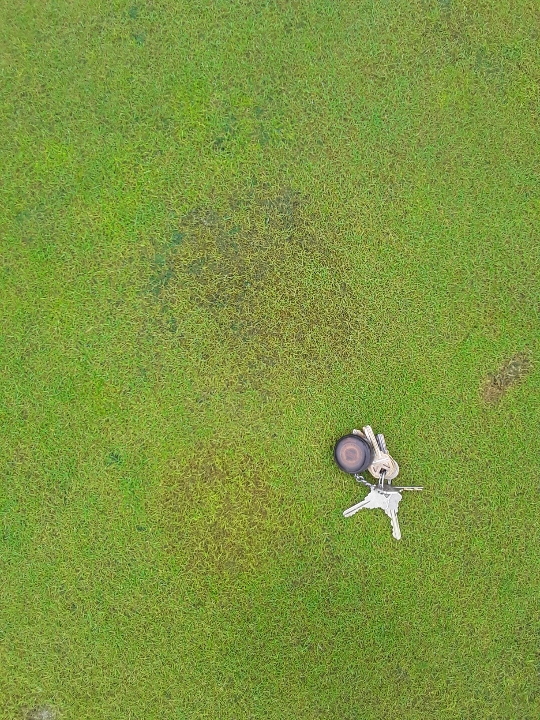
     Greens have struggled since July 1.  High heat, humidity and Nematodes have some of our greens hurting to say the least.  I have been applying nematicides to our greens to control nematodes the past 3 months.  I am killing some nematodes but not all especially Lance.  There is no nematicide on the market today that can effectively kill Lance nematode.  By killing the competition the Lance nematode have exploded in numbers.  I have tested #5, #6 and #9 greens and all 3 have come back positive for Lance nematode over the threshold.  No other nematode species was hardly found.  This is very disturbing.   After talking with Dr. Crow from University of  Florida yesterday all options for Lance nematode control are poor.  What our greens need is cooler temperatures so they can outgrow this pest.  At this time greens 1, 4, 5, 6, 9, 11, 12, 14 are hurting.  All of these greens have tested positive with Lance nematode this season and in past years. This is a problem we will be dealing with until a new nematicide comes out that controls Lance.
     So where do we go from here.  As you probably know we have raised the mowing height.  Our normal mowing height is .125 or 1/8''.  We have raised it to .140 or 9/64''.  That is 1/64'' higher.  Our 4 worst  greens 10 ,11, 12, 14 we are walk mowing at .180 that is just under 3/16''.  We will continue this until we get a significant break in the weather and we get some recovery.  #11 green is the most impacted green.  Nematodes are not the only problem with this green.  Sunlight is a big factor.  This green is not clear of shade until about 9:30 a.m. The trees that impact this green the most are on our neighbors property.  I have 2 trees on our side of the fence I will be removing this fall or winter  they impact the front of the green which is the weakest area.  Morning sunlight is very important to good healthy bentgrass greens.  We will also be clearing out all of the underbrush all the way back to #12 black tee to help with add air flow.  In the next 2 weeks we will be overseeding the greens with a newer variety of bentgrass.  The newer bentgrasses are not tolerant of nematodes but they are more drought and disease tolerant.  Nematodes are feeding on the root system making them shorter and more prone to wilt. The newer bentgrass will give us more time before wilt sets in.   I have been overseeding greens the past 4 years.  We are slowly converting our greens over to newer bentgrasses.
     This is very hard.  Losing grass is never fun.  I have worked on 3 other golf courses and never had to deal with nematodes at any of them.  What makes it  so bad is you are dealing with a nematode you can not kill.  By trying to kill it I have made it worse.  I ask to please be patience.  Cooler temps are coming and we will get through this.
#11 green shaded at 8:00am.
Up close look at Nematode damage #9 green.