Wednesday, December 3, 2025

Thanks


Dear Franklin County Country Club Staff and Members,

          I will be retiring from FCCC on December 31, 2025. It has been an honor to represent this golf course for the last 20 years, and I have taken great pride in all that we have accomplished in that time. This club has a long-standing history—spanning 100 years as of 2024—and I am very proud to have been a part of it. For 7 years I would drive by this course on my 45-minute trek to Innsbrook, and I always knew that if the opportunity ever presented itself, I would jump for it. It has been a dream come true to not only serve my hometown country club but also finish out my career so close to home.

I would like to thank the board of directors and the membership for welcoming me on that first day and their continued loyalty as the years progressed. Your constant dedication and love for this golf course pushed me to reach higher and tackle each day head-on. My goal was to keep FCCC as that one course members and guests could not wait to revisit, and none of that would have been possible if it weren’t for the wonderful clubhouse staff and dedicated team members, I have had the privilege of working with. This is no one-man show; it takes a team to keep this grass green, and I have been fortunate to have worked alongside many motivated and hardworking individuals. Moving forward, FCCC will be in great hands under new Superintendent Dave Thoenen, where 100 more years await on the horizon.

Looking back on my career I realize just how quickly time can propel us forward. With the blink of an eye I find myself in my office with boxes at my feet and pictures off the walls. My computer sits idle on my desk, filled to the brim with photos and documents from all the projects we have completed over these years. I have spent half of my career among the beautiful rolling hills of FCCC, and I cannot help but feel bittersweet as this chapter comes to a close. There is a lot I will miss, but the sunrises were always my favorite; FCCC welcomed some amazing ones, and as far as I’m concerned, there is no better way to start a day.


Thank you,

Ed Wachter


Wednesday, July 9, 2025

Fairway aerification

     We are giving our Fairways some love.  We are pulling cores out of the fairways to help with thatch reduction and gas exchange in the root system.  Oxygen is very important to turfgrass, they get oxygen through the root system.  Pulling cores, also help water movement into the soil profile more evenly. 

     This is a very slow process.  The tractor pulling the Pro Core is going around 2 mph.  It took us 5 hours just to aerify #1 and #2 fairways.  After the cores are pulled out of the ground they need to dry down.  We then run a metal drag mat across them to break them up.  The final step is to sweep up what is left with our Smithco Big Vac. 

      Looks like we will be working on this for about 2 weeks if rain stays away.  We need lots of sunshine to help dry the cores out.  While we are doing this, we ask that all carts stay off the plugs in the fairway.  Please keep your cart on the path until we can clean up the cores.


Pro Core in action

Dragging plugs
Cleaning up the left-over plugs
Finished 


Friday, April 4, 2025

Eight certainties of golf course management

 Here is an article that makes a lot of sense.  I thought I would share it.

Eight certainties of golf course management

© Adobe Stock

To paraphrase the otherwise dense 20th century German philosopher Theodor Adorno, when it comes to social criticism, only the exaggerations are true. In that spirit, I present the findings of my four decades of research into the everyday life of golf course superintendents. I can’t prove these hypotheses quantitatively. But I know they ring true.

1. The 90/10 Rule: At every club I have ever seen, 90 percent of the noise, complaints and discontent comes from 10 percent of the members. Half of them express themselves through a fog of self-induced, liquid medication; the rest of them are perpetual depressives intent on making everyone else as miserable as they are. No matter what, they are unhappy. My advice to greenkeepers, pros and general managers is to stop listening to them and to engage the rest of the members, most of whom are reasonable and agreeable to thoughtful measures of everyday management.

2. The 30/70 Rule: If you parse the operational budgets of most facilities, the golf course absorbs about one-third or less of the expenditure yet generates just under three-quarters of the revenue in terms of green fees, guest fees and share of initiation fees. Dollar for dollar, the golf course is a big moneymaker and subsidizes the rest of the facility’s operations — including every meal served.

3. The clubhouse is a sinkhole: Think of it as a variant of the Peter Principle (1969). What started as “people rise in a business hierarchy until they reach their level of incompetence” yielded “expenditures rise to meet income” and “junk expands to meet the capacity devised to store it.” In golf, the overhead costs of maintaining an enlarged clubhouse entail additional personnel, utilities and utilization such that you always end up falling behind. Whether it’s added service labor, HVAC, food waste or security, that new wing or expanded bar ends up sinking the operational budget further behind and puts the club in a deeper fiscal hole, which only drains funds away from the prime facility at any country club or golf facility: the golf course.

4. Cost per shot, bunker maintenance is a waste: More than 50 percent of all shots in a round are played onto, across or upon the putting surface. Meanwhile, your average golfer only plays three to four shots per round out of a bunker. From that standpoint, it is simply nuts that the cost for maintenance per square foot for bunkers is equivalent to that of greens. Economically, it makes no sense to groom meticulously what are supposed to serve as “hazards.”

5. Focusing on greens, fairways and tees guarantees 90 percent success: Given the perceptions and concerns that the vast majority of golfers have, a focus on “maintenance down the middle” is a guaranteed winner. The gains made by focusing on peripheral areas, especially the rough, flower beds and native areas, has what economists call diminishing marginal utility. In other words, it takes a lot of additional effort to make even very slight gains there. Start with the central lane of play and take care of that first.

6. Only 1 percent of play is from back tees: Most of the play at a golf course is from 6,500, 6,000 or 5,000 yards. Those are the players who are paying the bills. The back tees get about 1 percent of play, and most of that is from “industry comps” like college kids, ex-pros or golf business insiders. If you think I’m kidding, just check the divot wear pattern on those back tees. There isn’t any.

7. Defending par is easy: At most clubs there’s still too much emphasis on degree of difficulty or fixing a hole that is relatively easy. If you are really concerned about defending par, simply watch an average foursome play any hole. For the vast majority of golfers, the holes need to provide fun, variety and interest, not a masochistic obstacle course.

8. When it rains, the parking lot is empty: No matter how good the hamburger and onion rings, if weather conditions render the course unplayable for the day, the parking lot is empty. F&B consumption is a function of the golf. A modest menu and adequate service will thrive if the golf course is outstanding. If the golf course is lousy, the best steak in the world will go uneaten.

SPONSORED CONTENT

Broad-Spectrum Disease Control

Floxcor® fungicide controls over 26 turf diseases.

Bradley S. Klein, Ph.D. (political science), former PGA Tour caddie, is a veteran golf journalist, book author (“Discovering Donald Ross,” among others) and golf course consultant. Follow him on Twitter (@BradleySKlein).

Why can't we drive in the Fairways


     With the current weather pattern we have lots of moisture on the golf course.  We must be very careful this time of year since our warm season turfgrasses are just starting to wake up from its winter nap.  We need to be careful not to expose the turf to any unwanted traffic that can cause wear and compaction.  Some members might think it is dry since they do not kick up or squish any water while walking into the fairway.  That does not mean the fairways are dry.  They still have moisture in the soil and driving carts on  the fairways will compact the soil.  It takes more time for the soil to dry down when you have limited to no growth taking place by the turf.   Wear and compaction are serious issues that can severely damage turfgrass.  We may keep carts on paths an extra day or two before allowing carts to return to 90 degree.  I hope you understand.  We will open up fairways to 90 degree as soon as possible.  No need to complain to Clubhouse staff they have no say to cart path only or 90 degree.  The decision is made by the Maintenance Staff.


Cart Damage 
  

Tuesday, March 4, 2025

 The Club is looking at installing a new state of the art Irrigation system.  I know there will be a lot of question concerning why we would need a new system.  Below I have written a synopsis of our current systems faults and the proposed new system advantages.  I hope this will give you some idea of what we have here a FCCC.  The new system that is propose will transform this golf course to a higher level.  All playing areas will be elevated to a higher level.  Washouts, rough areas with no or little grass will be transformed to health turf.  If you have any question please don't hesitate to contact me.


Our current irrigation system has a total of 434 heads. Holes #1-2, and #4-6 have Toro electric heads that were installed in 1992, and holes #8-17 have Rain Bird Impact heads that were installed in 1989. Holes #3, #7 and #18 have the original Toro hydraulic heads that were installed around 1965. These heads are installed in a mixed configuration. We have some holes that are double rowed, with irrigation heads running down both sides of the fairway supplying water to both the fairway as well as the rough. The remaining holes are setup with either single rowed configuration – a single row of heads down the fairway – or a mix of single and double. All of the supply lines running into these heads are PVC pipe starting with a 10” mainline that runs from the pump station, which reduces down to 8”, and then 6”, and then eventually 3”. The current limitations of this setup are as follows:


  • The spacing between irrigation heads is too far apart leaving areas of the golf course without adequate coverage. The fairway heads are separated by 80-90’ and the green heads by 70’.
  • The mainlines are undersized. This makes it difficult and in some cases impossible to run multiple heads simultaneously without losing pressure. This reduction of pressure correlates to a reduction in water coverage.
  • A proper irrigation system is installed in loops, meaning each point on the golf course has water being fed from at least two directions. This creates a more efficient system overall. How is our current system setup?

     Holes #1-3 are looped together, but water is only being fed from one direction. The farther you get from the mainline the less pressure there is.

     #4-6 are not looped and each result in a dead end. Water comes in and stops once it reaches the end.

     #7 is not looped (dead end).

     #8, #9, and #18 are looped with water coming from two directions (good!).

     #10 is not looped (dead end).

     #11-13 is looped together but again water is only being fed from one direction.

     #14 and #15 are not looped (dead end).

     #16 and #17 are looped with water coming from two directions (good!).

            As you can see our current irrigation system is a mixture of dead ends and single fed loops with   only a few holes setup with proper loops. Having water come from at least two directions       allows for the entire golf course to be irrigated more efficiently without a loss of pressure. 

  • There are very little isolation points for our current system. Any leaks in a fairway require shutting down entire holes, if not multiple holes, just to make a repair. If an extensive repair is required this means large areas of the golf course could go without adequate irrigation.
  • PVC pipe has to be installed in sections, and these sections need to be glued together. Over time this glue eventually breaks down causing leaks and blow outs. We spend on average $5000-$6000 a year on mainline repairs. The average lifespan of PVC is 20 years.
  • We have a mixture of irrigation heads on the course. While most are electric heads we still have 3 holes that are older hydraulic heads. The front 9 are Toro and the back 9 are Rainbird. Having 2 different brands and also different styles of heads causes us to have to stock separate replacement parts for each.


The new proposed irrigation system will include roughly 1000 RainBird heads allowing for a more efficient “wall to wall” irrigation setup, making sure every playable area on the golf course gets adequate coverage. Every head in the system can be individually controlled allowing for a more versatile system. This eliminates the need to have multiple heads running for a single dry area. This also adds the flexibility of running multiple heads for different durations. There will also be a considerable increase in the amount of valves on the course making it much easier to isolate a repair. Instead of closing down entire holes, we would be able to close off just a single line of heads. All supply lines and mainlines will be replaced with HDPE piping (high density polyethylene). This pipe is more flexible and all the joints are welded together allowing for it to be installed in one piece instead of in sections. This removes the need for glue which creates a much more robust system overall. The lifespan of HDPE pipe is 50 years. The mainlines for the new system will not only be larger in diameter, but they will also extend farther out from the pump station. This will increase water volume and pressure allowing us to irrigate multiple areas of the golf course simultaneously. Below are some general questions regarding the new proposed system:


  • What are the head spacing's of the new system?

     Fairways – 70’

     Roughs – 70’

     Greens – 50’

     Tees – 50’

  • What are the diameters of the new piping?

     12” from the pump house, reducing to 8”, down to 6”, and then eventually 4”.

  • How does HDPE pipe compare to PVC?

     HDPE pipe is more flexible. As water surges through the system the pipe will naturally expand and contract slightly; HDPE pipe can handle this stress while PVC, being a stiffer plastic, will weaken over time.

     The joints of PVC are also glued together. This glue tends to break down first. HDPE pipe is “heat fused” together essentially creating one long piece of pipe. This heat fusing seals the pipe together like a weld and this seal is actually stronger than the pipe itself.

  • How are the pipes installed?

     12”, 8”, and 6” pipes will be trenched. The 4” and 2” pipes will be pulled in by a vibratory plow

  • How long will the installation take?

     Weather permitting, 2-3 months.

  • How disruptive will the installation be to playing conditions?

     Using a vibratory plow on the 2” – 4”  pipe makes for a cleaner end result, eliminating the need to back fill a trench. The plow essentially pulls the pipe into the ground and the remaining hump is smashed down. This means there will be no trenching through fairways.


  • Will the old system be removed?

     All the old heads, valves, and satellite boxes will be removed. All the old PVC pipe will remain in the ground (unused).  

  • Will the existing wells have the capability to supply the new system?

     Yes, as long as all three pumps are operational.

  • Does the new system come with a warranty?

     All heads and swing joints have a 1 year warranty. Pump station has a 3 year warranty. All workmanship is warrantied up to 10 years depending on the installer.

  • Are there any other golf courses in the area that have this system?

     Meadowbrook Country Club

     Berry Hill

     Ballwin

     West Wood Country Club


Thursday, December 19, 2024

Living with Nematodes

Been few years since I published anything on my blog.  Here is a article I submitted to my local Chapter.  It is my journey battling Nematodes.  I hope it might help others that are having the same trouble I was having.


Living with Nematodes         

            I have been a superintendent for 38 years, and in that time I have had my fair share of ups and downs, but nothing was quite like my battle with nematodes. What started as a minor annoyance ended up becoming a full-on tug of war spanning six years, and filled to the brim with peaks of hope and valleys of utter frustration. I went through many products, most of which had little to no effect, sat through many hours of seminars and webinars, and showed dying turf to anyone who wished to see it in hopes of collecting as much advice as I could both personally and professionally. After discovering nematodes were at the center of my problems, and not just any nematode but Lance, I searched out anyone who had any information about them and more importantly how to get rid of them, but as I would slowly begin to learn Lance is a tricky adversary, and if I was going to succeed in this journey I would need to be well prepared. I committed myself to endless amounts of research and trials until finally arriving at a solution that I have been implementing now for three years with tremendous success. It has been a long road through a grueling storm, but I can confidently say that I am on the other side of it, and that the grass is much greener over here.

            In 2008 Nemacur was discontinued, and little did I know how much of an impact that would have on me moving forward. Back in the day if you had a nematode problem you could throw down some Nemacur and be good to go; so Nematodes as a pest never concerned me much. In 2005 I arrived at Franklin County Country Club excited and determined to make this the best course I possibly could. As the years went by I began to notice a pattern developing in a few of my greens; I was losing turf in the same small areas year after year. I thought it might be isolated dry spots so in 2012 I purchased a moisture meter and to my surprise the spots were not dry at all. I plugged the small affected areas and continued to monitor, and it wasn’t until 2015 when things took a turn. A couple more of my greens began showing these weakened patches of turf, this time much more severe. This had to be disease I thought, and sent some samples to Dr. Miller at the University of Missouri. They all came back negative for disease, but he did find a Root Knot nematode in the roots. He sent the sample to the nematode labs and those results came back with Root Knot and Lance right below threshold levels. Dr. Miller thought having two species of nematode near threshold levels was too much and advised I spray Avid. After the Avid application everything went back to normal. Success! No, the battle was just beginning.  

            In 2016 I went on the Syngenta Avid and Heritage program. I purchased enough products for three applications, May-July. At the end of my last application things were not going well. I was confident this had to be disease; after all, I was on a preventive nematode program. I sent some samples to Dr. Miller and once again, no disease. At this point I had large areas of turf dying, so on a whim Dr. Miller sent my samples to the nematode lab. My results came back with over 1200 Lance per 100cc of soil. That’s ten times over the threshold! The Avid wasn’t working, and I had to find a solution quickly. I began researching Nematicides that could control Lance nematodes, but there was only one other, Nemacur. I was able to find five bags locally and within two days of the application my infected greens were improving. I was hoping this would be the end of my troubles. I would plug the areas of dead turf and by next year it would all grow in leaving a nice playable surface with not one single nematode in sight. Wishful thinking I suppose, because by 2017 they all returned, and I was out of Nemacur. I needed an alternative.

            While researching Lance nematode control I came across Nortica from Bayer. Dr. Crow from the University of Florida had done testing with Nortica and it showed outstanding results. I also reached out to other golf courses that were having nematode issues and through them I discovered Rev by Dakota Peat and Worm Power.  Using a combination of these products I had good success, but unfortunately it was short lived. In 2017 Bayer sold Nortica, and Worm Power became too expensive. I was back to square one.

            Syngenta came out with Divanem in 2018. This was a more concentrated form of Avid, and after using up my supply of Nortica, I needed something to fill those shoes. In 2020 I sat down with Syngenta at the golf show in Orlando and they confirmed that Divanem would kill Lance nematodes. I took their advice and went on the Divanem and Heritage program, but this time with a twist. What if I needle tine greens before putting the product down? That way I could get the Divanem down closer to the Lance, take the fight right to their doorstep. I filled up my sprayer with confidence. This was going to be it, this was going to work, I thought. The battle commenced, and once again Lance proved to be more resilient than I originally anticipated. I was left with eight greens in bad shape, as I limped through the remainder of the summer plugging, seeding, and topdressing, tail tucked firmly between my legs. Not only were they infested with Lance, but I also had Pythium Root Rot which is common in nematode infested root systems. I was losing, and it was happening fast.

            In August of 2020 I sat in on a webinar with Dr. Crow. I needed to learn everything I could about Lance and why it was so hard to get rid of. I asked Dr. Crow about applying Divanem after a needle tine and he informed me that the control of Lance cannot be achieved with Divanem because Divanem binds to organic matter. So while you may kill the nematode close to the tine hole, the nematodes between the holes can still party on. On top of that bombshell he also said that regular use of Divanem will give you higher levels of Lance, because while the other species of nematodes are affected by the product, the Lance is not, resulting in an environment with very little competition, which is an open invitation for infestation. I was shocked. This whole time, I was making my problems worse.

            With the news from Dr. Crow I had to rethink my approach to nematode control. I started looking for natural products that could manage nematodes while also building a healthy root system. My thinking was if I could build the best roots possible maybe that would help curb some of the nematode damage, because as far as I was concerned I was going to have to learn to live with these worms. During my research I came across a promising option; chitin. Chitin is found in the shells of crustaceans and insects, and it is shown to have outstanding soil building properties. Digging a little deeper I found other chemicals that toot the same horn. Chitosan, Quillaja, Yucca, and Harpin Protein.  Chitosan is a liquid version of Chitin and encourages various bacteria and fungi, some of which feed off of nematodes and their eggs. Quillaja acts as a wetting agent, but it is also antagonistic towards nematodes affecting their nervous system. Yucca is a wetting agent and feeds soil microbes, while Harpin protein acts as an elicitor, sharpening the natural defenses of the plant. Harpin Proteins have also been shown to suppress nematode egg production. Using all of these ingredients together creates an environment that is not only hostile to nematodes, but also promotes and encourages a healthy soil biology.

            As for the products, there are many out there that contain these natural ingredients. Early in my search I came across a green grade fertilizer by Ocean Organics called Sea Blend that contains kelp, fish, and crab, but that was the only product at the time that was available for the turf market. I had to shift my focus to the agriculture and landscaping markets to fill out the rest of my arsenal. Terra Biotics was one of the first companies I found that makes micronized sprayable products that contain fish, crab shell, and other natural and biological ingredients. This provides beneficial microorganisms and the necessary carbon and nutrients to allow this biology to thrive. A company out of Georgia, Organisan Corporation, makes a natural nematicide called Nemasan. It contains Chitosan and Quillaja. They also make a natural wetting agent, OIIYS; a combination of Chitosan and Yucca. These products were marketed towards the agriculture market, but for the past two years Organisan has had a booth at the annual Golf show. For my Harpin Protein I found the company Plant Healthcare who distribute ProAct. I went this route because they offer a larger twenty ounce package. After receiving all of my products, and building a game plan, I looked towards the 2021 season with a slight hesitation. This had to work, I was running out of options and if I had a repeat of the 2020 season, I would more than likely be looking at early retirement. My back was against the wall, and I was down to my last strike.


            2021 was the first year I put my new program to work. My goal was to control 25-40% of the nematode population while also focusing on establishing the best root system possible. No conventional Nematicides were going to be used. To say I hit a home run might be a little dramatic, but I definitely didn’t strike out. I cruised through the 2021 season with zero nematode damage and greens that were improving by the day. I continued taking nematode assays the entirety of the year and to my surprise I still had some greens with nematode counts above threshold levels, but no symptoms were present. Dr. Crow informed me that when they do a nematode assay they not only count living nematodes, but also dead ones. Regardless if what I was doing was killing them outright, or simply making their lives a living nightmare, it was working, and after three years on this program my greens have never been better. They are firmer, denser, and more drought tolerant, but above all else, I have had zero nematode damage. I spent a lot of time battling these nematodes, devising many different plans of attack and using many different chemical products that had no affect on the nematodes themselves, and later I discovered actually did more harm to my soil biology than good. It wasn’t until I shifted my focus away from the nematodes and more towards my soil as a whole that I started to see results. Instead of trying to bomb these pests out of existence and while doing so disrupting the natural micro organisms in my soil, I began to promote and stimulate these organisms. Some of them are good at harassing nematodes, while others simply take up space not giving the nematodes enough room to infest and take over. A balanced ecosystem thrives, naturally setting its own checks and balances. Without this balance in the soil things can become chaotic very quickly, which is not a pretty sight on greens, trust me. I had to learn how to live with nematodes, because they too have their place. A diverse soil biology that is encouraged and maintained may be the biggest advantage over the control of nematodes.


Thursday, December 9, 2021

Winter Golf

     I know weather has been very mild for November and December.  We have had a few frost delays but not many.  Here is a good video from the USGA that explains the damage walking on frosted greens can do.  Remember when we have a frost delay all members must start on hole #1 no exceptions.  If you jump to #4, #7 or #10 you will reach greens that still have frost on them.  Playing from #1 all green will have time to thaw before first golfer reaches them. 

https://www.usga.org/content/usga/home-page/course-care/green-section-record/59/issue-20/frost-delay-its-worth-the-wait.html


Tuesday, November 9, 2021

Cart Paths

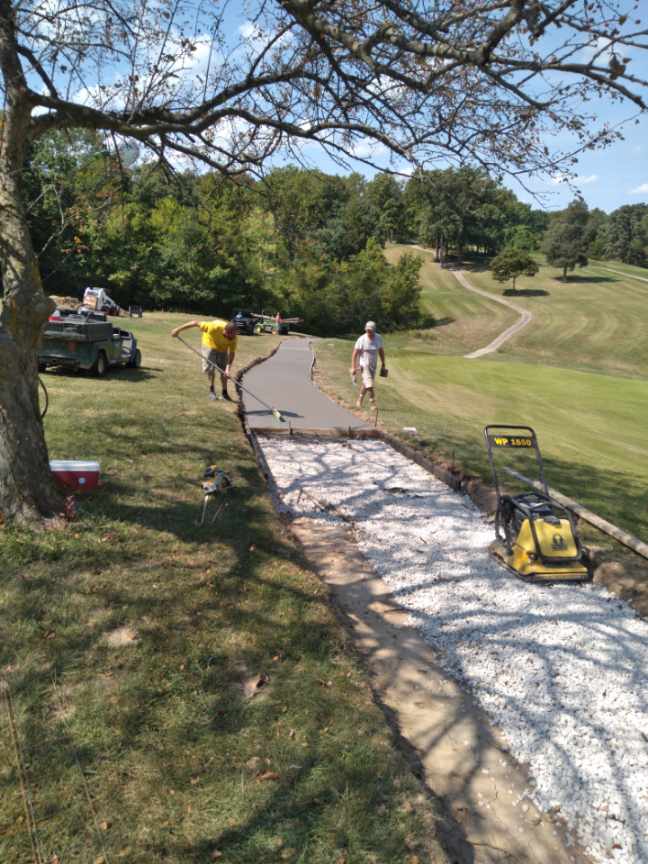
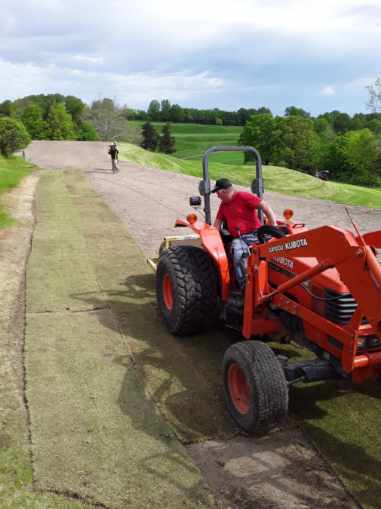
      We have been busy replacing some bad cart paths.  Dobsch Construction is doing an outstanding job.  All sod work is being done by my staff.  So far we have done #18 from top of hill all the way to green.  #1 bad spots coming up to green and then around curve up behind green.  #15 at the bottle neck no more dip in path.  We still have to do #5 green, "#12 cart path up by 13 white tee and the rest of #18 and the cart path down to #9 green and #7 tees.  We are not going to stop with these paths I hope to add more.  I am looking at fixing #7 path from bridge to 8 tees and replacing # 8 path all the way to new path at green.  Our goal is to take out all the old 5 foot wide paths and replace with 6 foot. Most of our 5 foot paths are on the back nine which is the hardest paths to access with concrete.  Here are a few picture of our work.


Removing old path #18

It took 7 truck loads to pour the entire length of #18.


    #18 path is finished  


 #1 first part completed

#15 looking back to tees.
#15 completed

Thursday, August 5, 2021

Greens


     Big difference a year makes.  We have been getting numerous positive comments on the condition of our greens.  My staff and I appreciate it very much.  Summer is not over yet and Nematodes are still present in our greens profile.  We need to make it through August and we are home free.  So what has changed from this season to last season.  One big difference is I stopped trying to kill Lance Nematode with conventional  Nematicides.  This did not work and only made the problem worse.  The years up to the time we found out we had a Nematode problem we did not treat our greens for Nematodes.  We would have a few problems during the summer the greens would repair themselves or we would plug the bigger areas.  I always thought those problems were from drought stress.  We now know it was Nematodes.  Once I found out trying to kill Nematodes with Nematicides was hurting me I looked for biological controls to fight this pest.  The biological products I found have some activity on the Nematodes and there eggs.  These products also have an added benefit they help build soil biology which give the Bentgrass plant deeper and stronger root systems. Chitin, Yucca, Harpin protein and compost are the products I add to my program.  Chitin is the first product I found that builds soil, tricks the plant to defend itself.  Chitin is ground up Crab Shells.  I am using this in the liquid and dry form.  We are using 6 different products that have liquid or soluble Chitin in them.  My greens granular fertilizer we use after aerification has the dry form of Chitin in it.  I am also using a product that has Harpin protein in it that helps reduce Nematode eggs and it also helps build soil biology.  Yucca plant extract is a natural wetting agent and it also builds soil biology. The last product we are using is compost.  I am mixing compost with our aerification sand and incorporating it in the green profile when we aerate greens.  The compost helps build our soil biology and it has a fungus in it that feeds on Nematodes. As of today this program is working.  These products are not in the main stream golf course fertility and pesticide warehouses.  It is sort of like taking a supplement or herb instead of a pharmaceutical pill to treat some disorder. This golf course is a testament that these products have a positive effect to our greens.  If we can get to September without significant damage This will be the best year we would have in a long time.  These products will also work on your landscape, garden and house plants.  Google Crab Shell meal or extract, yucca plant extract or harpin protein.  Thanks for reading my blog.
Tuesday, May 18, 2021

Course update

     It has been awhile since I last updated my blog.  Lots of thing have been going on.  Spring is here and summer is not far off.  Over the past winter we cut down 40 trees and cleaned up the tops of 10 trees to the right of #1 green.  I can tell you this my staff and I are tired of cutting timber.  These tree removals will improve playability of the golf course.  We still have work to be done.  All of the stumps have to be remove.  My stump guy has us on the schedule.  When stumps are cleaned up we will sod cart paths at #1 green and #10 green.  This will be a big improvement to these 2 areas.

     The Driving Range Tee, #4, #6 and #9 Black tees got a makeover this month.  We stripped all sod off the tees, tilled them up and laser leveled all four tees.  It took almost 2 weeks to get new Zoysia sod.  The rain kept sod farm too wet to cut zoysia sod.  We laid sod and then it decided to turn unseasonably cool.  The zoysia on the tees is finally sending roots down.  We are trying to get these tees open by end of May. 


                               Tilling up Tee                                            Laser leveled tee

                                                                           
laying sod
completed


    We just had Commercial Turf here to root prune all trees along fairways, tee and greens.  This will help our turf in all areas.  Trees will out complete turfgrass for water and food.  We will need to redo this about every 2 to 3 years.  The machine has 2 knifes 12'' apart cutting 9 inch deep slit.  This does not harm the trees.  We were cutting feeder roots just on the edge of the drip line.


Wednesday, February 17, 2021

Big Freeze

      It is that time of year.  With the bitter cold temperatures the ground has frozen solid.  Later in the week we will have temperatures climb up to near 50 degrees.  Greens need to thaw to at least 2'' before play is allowed.  The green surface needs sunlight to help in the thawing process.  Snow cover will slow this process up.  When snow melts we will be checking greens multiple times a day when we have at least 2'' of thaw in all our greens we will open.  Root shearing can cause severe turfgrass problems.  Diagram below show how root shearing is done by playing on thawing greens.  Thanks for your cooperation.   


Tuesday, February 16, 2021

Tree work

     We have been very busy working on underbrush and tree removal the past 2 months.  We started with underbrush to the east side of 10 green and worked our way down the fence to 12 black tee.  Air movement is what we are trying to enhance on 10 and 11 greens.  The next  thing was to remove 10 trees around 10 green.  This will help with light, air movement and help establish much better turf on the back side of 10 green.  We will be removing 4 trees to the south and east of 11 green also.  These trees are shading 11 green.  All trees removed were trees selected by the USGA Agronomist John Daniels during his visit last summer.  There are 2 trees at #11 we are cutting down because they are leaning heavy over the fence.  If they fall it will destroy the fence giving the cattle access to the golf course.


     Some of the trees removed from #10 were in bad shape.  We cut two trees down that were hollow.  the picture below is the tree that was right next to cart path leaving 10 green.
     After we remove the stumps we are going to grade and sod both sides of cart path behind 10 green.  This will be a huge improvement.  Trees will not allow good turf to grow under them.  Below are some pictures of both 10 and 11.

10 green

We chipped the tops

10 green

11 green

We cut brush and then chipped it with our chipper

11 green completed

My staff has worked very hard.  We were able to cut down and clean up 2 trees a day unless play was heavy.  We had a few days the golf course was extremely busy for winter.


Friday, October 16, 2020

Course Update

      It has been awhile since my last post.  We have been very busy.  We have a number of project that have been completed.  One of the biggest accomplishments is our greens are almost healed up from the Nematode and Root Rot issues from July.  This was the hardest summer I have ever had in my 35 years as a Golf Course Superintendent. I am optimistic this will not happen again. I have a different approach for next year.  I am  build my soil biology up with biological products that will grow greater root mass in our greens and have a negative effect on Nematodes.  Some of these biological product are in fact natural Nematicides.  I have always used biologicals but not to this extreme.  Some of these products  like crab shell meal, soap box tree extract, compost, sesame seed oil all have some degree of control to Nematodes.  I am also using some forms of Bacteria and Fungi products that also have  control against Nematodes. I know I will not kill all of them but if I can keep numbers low enough to get our greens through July and August with minimal damage that is a win.
Here are the list of project we completed since  August.  

  • #4 fairway bunker was rebuilt.
  • #8 cart path from ditch in front of green up past merge from #17 was fixed.
  •  #1 trees to north of green were removed to help with turf loss on right side of green below bunker. 
  •  Aerified all greens.
  •  DryJect all greens.
  • Fixed cart path washouts on holes 6 and 12. 
  • Sprayed second application of Bermuda grass control on fairways and tees.  
  • Fix sink hole that developed at the front entrance from bad culverts.
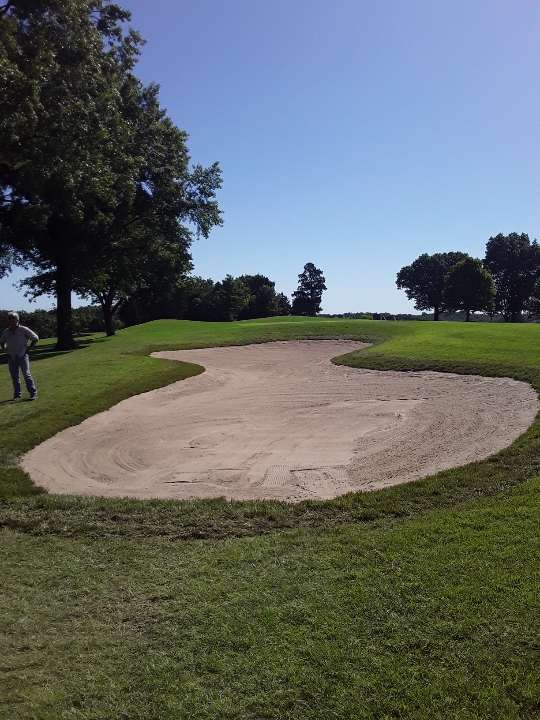
     #4 fairway bunker was reshaped and bottom was raised about a foot.  New drain lines and sand installed.  This was a much needed improvement.  

Schaefer-Meyer edging bunker
#4 bunker finished

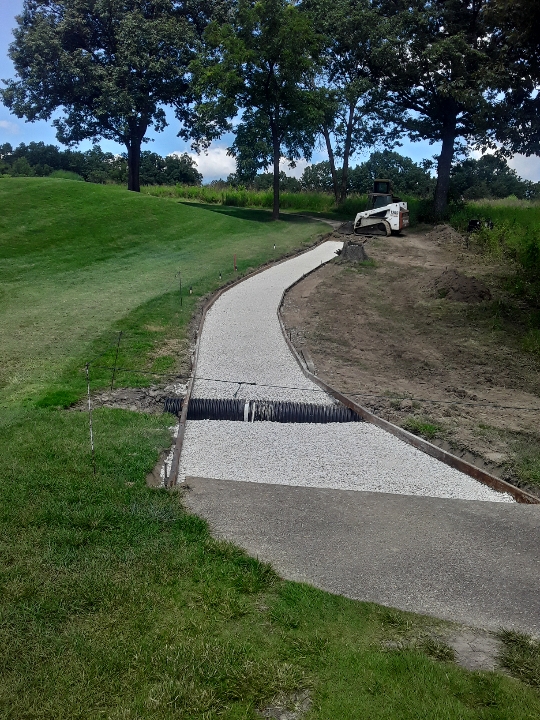
     #8 cart path was in bad shape.  We had about a 2 foot ditch running under the path.  We also put a culvert in at ditch crossing.  No more carts running through water.  Dobsch Construction did great work.
You can see the ditch running under path

Ready for concrete
Just finished second pour.
Sod going down.

     We removed some big trees to north of #1 green.  It is very hard to get any turf to grow near the cart path.  The large trees were taking all of the moisture.  This will help us to maintain better quality turf from the bunker to cart path turn behind #1 green.  We still have to remove the under brush and clean up the tree tops.

Before from back of green

Before front right of green
After from behind green
After from front right of green

     We aerified all of greens twice this fall.  In late September we punch holes with our ProCore.  This is the first time we were able to aerify, topdress, brush, apply fertility and water in one day.  We used 3/8 tines.  Most holes were filled in by the end of the week.

Picture taken after we brushed greens .

     October 5th we did a new process called DryJect.  DryJect takes water to create a void in profile of green and sand is sucked back into the hole.  I ordered some finely ground compost and we mixed it with our dry sand.  We used 80 lbs of compost to 2000 lbs of sand.  This makes roughly a 95% sand to 5% compost blend.  The compost will give our greens organic matter to help fight off Nematodes.  The compost product has shown some good success in Florida.  We will do this again next March before we core aerate.  DryJect is very labor intensive.  The DryJect crew brought 2 machines.  We needed 3 people per machine to keep our blended sand in machine as it went across green.  We used 24 tons of sand and it had to  be hand loaded into the hopper of the DryJect machine.

Loading DryJect machine

3''X3'' hole pattern

     The cart paths that cut across the fairways on holes 6 and 12 were repaired.  This is not the first time we have repaired these two areas.  Water uses the edge of path on 6 and it cuts out the sod.  Once water get a channel it keeps on eating it out.  #12 cart path is a different situation.  Before we put the catch basin in at the fence any big rain event we would get mud and silt would come down from the farm to the north of the golf course.  Just before you make the turn to go across the fairway we have about 1 foot of mud and silt that was washed down from the farm above us.  This changed the drainage pattern of the rough and fairway.  Water now sets along the cart path when it used to flow down the hill to the ditch.  We will see if our fix will work.  We might have to put a catch basin in at cart path if it comes back.

Cart path at 12 Fairway.

     The past 3 years we have been spraying the bermuda grass encroachment in our fairways and tees.  This is a slow process Bermuda grass is relentless.  Just like the Energizer bunny it just keeps going. We are making some progress.  I am using two different herbicides to take the Bermuda grass out of our Zoysia fairways.

The off color turf is Bermuda grass
Closeup of Bermuda grass injury from herbicides.


     Lastly we found a sink hole at the front entrance.  After some exploratory digging we found the problem.  We have 2 culverts that merge together at our driveway and Country Club Rd.  The old forms that were used to connect the two pipes into the concrete box culvert going under Country Club Drive rotted away and the gravel under the asphalt was washing into the box culvert.  Luckily we found this before a vehicle did.  We replace both rusted culvert pipes. We replaced them with ADS plastic pipe, concreted it back to the box culvert running under Country Club Rd.  We need a good rain so the rock fill can settle.  After fill has settled we will repair asphalt.
Old culvert running into box culvert.
  
Installing new culvert pipe.
Concreting pipes into box culvert.